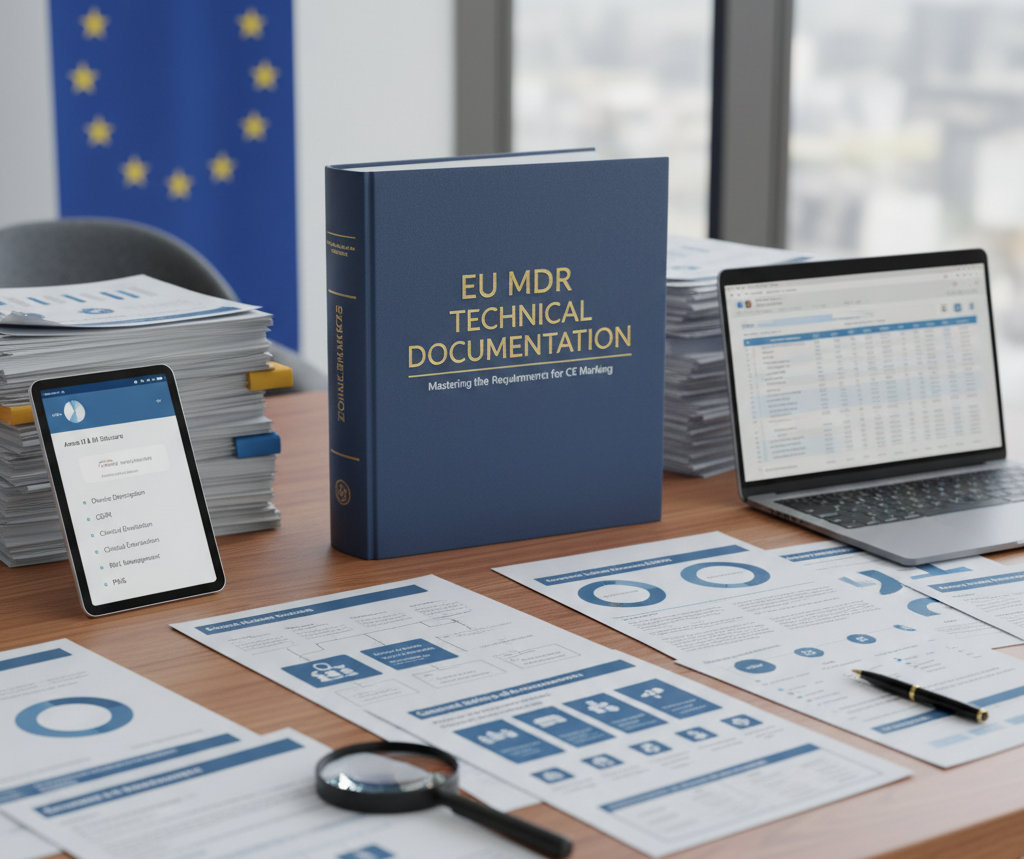
The European Union’s EU MDR (Medical Device Regulation 2017/745) sets strict rules for technical documentation. Knowing these rules is important for getting CE Marking and accessing markets in Europe.
The Technical Documentation Structure
EU MDR Technical Documentation must be organized according to Annex II and III, covering:
- Device description and specifications
- Information provided by the manufacturer
- Design and manufacturing information
- General Safety and Performance Requirements (GSPR)
- Benefit-risk analysis
- Product verification and validation
Device Description Requirements
Complete device information must include:
- Intended purpose and indications
- Principles of operation
- Technical specifications
- Variants and accessories
- Reference to earlier versions
General Safety and Performance Requirements (GSPR)
The GSPR checklist (which replaces the previous Essential Requirements) must show compliance with all relevant requirements from Annex I, including:
- Chemical, physical, and biological properties
- Infection and microbial contamination control
- Device design and environmental properties
- Devices with diagnostic or measuring functions
- Protection against radiation
- Electronic programmable systems
- Active devices and connected devices
Clinical Evaluation Report (CER)
The CER is an essential component that shows:
- Clinical evaluation plan and methodology
- Current knowledge and state of the art
- Analysis of relevant literature
- Evaluation of clinical data
- Conclusions on safety and performance
Risk Management Documentation
Complete Risk Management according to ISO 13485 and ISO 14971 must include:
- Risk Management plan
- Risk Analysis for all life-cycle phases
- Risk evaluation and control measures
- Evaluation of overall residual risk
- Risk management report
Post-Market Surveillance
Technical documentation must include plans for:
- Post-market surveillance system
- Post-market clinical follow-up (PMCF)
- Periodic safety update reports (PSUR)
- Vigilance reporting procedures
Conclusion
Well-prepared technical documentation not only ensures compliance with EU MDR but also shows your commitment to device safety and performance. This builds trust with regulators, notified bodies, and end-users.